L
/Laches A doctrine in Admiralty Law in which a party’s failure to do the required thing in a timely manner causes the party to lose that right of action; e.g. unreasonable delay in asserting a claim
Laden
Loaded aboard a vessel.
Lading -See "Bill of Lading."
LAE (Loss Adjusting Expenses) - see "Allocated Loss Adjusting Expense."
A heavy article thrown overboard with a buoy to mark where it is located for recovery at a later time; e.g. crab pots.
A vessel removed from active operation or navigation.
Landbridge
Movement of cargo by water from one country through the port of another country, then by rail or truck to an inland point in that country or to a third country; e.g. a through-movement of Asian cargo to Europe across North America.
Landed Cost
The total cost of goods to a buyer, including transportation, duty, and other costs.
Landed Value
Market valueof cargo at destination on the final day of discharge from the ocean vessel.
L.A.S.H. (Lighter Aboard Ship) - See "Vessel Types" Appendix F.
Lashing
Wire, rope, turnbuckles, chains, etc. used to secure cargo in a container or truck trailer, or to secure cargo or containers on a vessel to prevent shifting during transit.
Latent Defect
Any defect which has not resulted from wear and tear and which cannot be discovered by a diligent Assured through the use of any known or customary test. In particular, latent defects are not limited to defects in metal.
A grid system of reference in which every point on the surface of the earth can be located using its unique coordinates:
- Latitude lines (called Parallels) circle the earth and are parallel to the Equator. Latitude locates a point’s distance North or South of the Equator, and is measured in degrees, minutes, and seconds, from 0º at the Equator to 90º at the North Pole or South Pole.
- Longitude lines (called Meridians) radiate from the North Pole to the South Pole and are not parallel. Longitude locates a point’s distance East or West of the Prime Meridian (Greenwich, England), and is measured in degrees, minutes, and seconds from 0º at the Prime Meridian to 180º at the International Date Line.
For example, San Francisco has coordinates 37º 48' N and 122º 24' W and is located on:
- A Latitude line 37º 48' North of the Equator, and
- A Longitude line 122º 24' West of the Prime Meridian.
Latitude Lines + longitude lines = grid system

- The number of days a vessel is out of the water for maintenance work, repair work, or storage. See "Haul Out" and "Haul Days."
- The number of days a ship may use a dock for loading or unloading cargo before demurrage is charged.
- The number of days between yacht races to allow repair of vessels and crew rest.
Laytime
The amount of time a vessel is allowed to remain in port before incurring delay penalties. See "Demurrage."
Lay-Up - See "Laid-Up."
Lay-Up Returns
A return premium given to the Assured by the insurance company for periods the vessel was not operated during the policy term.
L/C (Letter of Credit)
LCL (Less than full Container Load)
Shipments oftwo or more shippers consolidated into one container to make a full container load.
Lead Underwriter
The insurance company which sets the terms and usually accepts the largest participation in a joint or subscription policy and the other subscribing companies usually agree to follow.
League - See "Weights and Measures" Appendix E.
Legal Liability
Responsibility imposed by law.
A document issued by a bank and used to pay for cargo. The buyer arranges a letter of credit from its local bank, creating a fund in a foreign bank near the seller in a specified amount in the seller’s favor. The buyer authorizes the seller to draw drafts against the fund for goods purchased by the buyer. A sum of money is paid to the seller under specific terms and conditions, including the receipt by the bank of certain documents within a given time. See "Cargo Terms of Sale" Appendix G.
Letter of Indemnity
A letter agreeing to reimburse a party or hold it harmless for loss or damage. It is sometimes used as a fraudulent practice in which a cargo owner gives a vessel owner a guarantee of "no claim" if the vessel owner issues a clean bill of lading to the cargo owner to satisfy a letter of credit requirement, when the cargo laden aboard is actually damaged.
Letter of Undertaking
A letter issued by a Protection and Indemnity Club or other financial organization guaranteeing reimbursement to a party for loss or damage (usually to cargo). It is a more informal form of security and less expensive than posting a bond to guarantee performance. However, it is only as good as the good faith of the entity issuing the letter as there is no third party (such as a bank or insurance company) to guarantee performance.
LHWCA – See "Longshoremen's and Harbor Workers' Compensation Act."
Liability Insurance
Insurance to cover the legal responsibility of an Assured.
A property right in which a party has a legal claim upon cargo or vessel for the satisfaction of some debt or duty.
Ligan - See "Lagan."
Lighter - See "Barge" under "Vessel Types" Appendix F.
Lighterage
Transportation of cargo between an ocean-going vessel and the pier by a smaller vessel called a lighter or barge. A lighter is used when the water is not deep enough for the ocean-going vessel to lie alongside the pier or wharf, or when the discharge facilities of the port are so congested that lighterage is more efficient.
Limitation Of Liability Act - See "Carrier’s Liability Acts (Ocean)."
Line of Demarcation
The line between two points where the navigational rules of international waters and inland waters meet. see "Colregs."
Liner
A vessel sailing between specified ports on a regular schedule (as opposed to a "Tramp Steamer" which has no regular schedule).
Liner Negligence Clause
Replaces Inchmaree Clause in the Hull policy and provides virtually All Risks coverage on a vessel, as long as the damage does not result from want of due diligence by the vessel owner.
List
The amount of vessel tilt or heel (measured in degrees) from the vertical upright position. A list can be caused by improper stowage or shifting of cargo or fuel to one side of the vessel, or a flooded tank or hold. It is different than the normal rolling that a vessel experiences as it rides over the waves in the ocean. See "Vessel Stability."
Lloyd’s Agent
A representative of Lloyd’s of London located in ports throughout the world. They serve three primary functions:
- Reporting the arrival and departure of vessels.
- Inspecting vessels and issuing certificates to show they maintain their "Class."
- Surveying cargo losses for Lloyd’s members.
Lloyd’s Agents are also nominated by various marine insurance companies to act as cargo survey or settling agents.
Lloyd’s Confidential Index
A listing of vessels with descriptions, data, major claims, prior vessel names and owners on each vessel registered at Lloyd’s. The index also shows all vessels in a fleet under common ownership or management.
Lloyd’s Register
An alphabetical listing of vessels including their specifications and other information valuable to shipping and marine insurance industries.
Lloyd’s Register of Shipping
An organization maintained for the surveying and classing of vessels so that insurance companies and others may know the quality and condition of the vessels offered for insurance or employment.
LNG (Liquefied Natural Gas carrier) - See "Vessel Types" Appendix F.
A mark on a vessel’s side indicating the maximum depth to which it may be safely immersed when loaded with cargo. This depth is variable and depends on the waters of operation, time of year, and type of cargo; e.g. winter, North Atlantic, timber will have a special depth. Laws regulate the amount of cargo a vessel can carry and still maintain enough reserve buoyancy and a low enough center of gravity to ensure its safety in adverse weather and dangerous seas. The white areas in the pictures below are empty spaces for paying cargo, and the remaining space houses a vessel’s main and auxiliary machinery, living quarters and supply lockers.
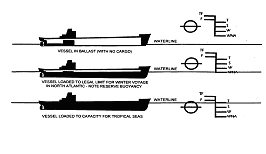
While there are other load lines, the most common is the Plimsoll Mark, which was established by the British Parliament in 1876 to prevent overloading of vessels. It was named after Samuel Plimsoll, a member of British Parliament, who was interested in maritime safety.
Deck Line ____________________ 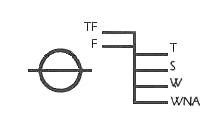
The Plimsoll Mark | The letters signify: TF Tropical Fresh Water Load Line F Fresh Water Load Line T Tropical Load Line S Summer Load Line W Winter Load Line WNA Winter, North Atlantic Load Line |
Loan Receipt
Document signed by the Assured acknowledging receipt of money advanced by the insurance company as an interest‑free loan (instead of payment of a loss) repayable to the insurance company only if the loss is recovered from a third party and then only to the extent of the recovery.
LOC - See "Letter of Credit."
Lock
An enclosed area of water with a gate at each end. Water can be let in or out to raise or lower vessels from one level to the next through a canal or around a dam.
Longitude - See "Latitude / Longitude."
Longshoreman / Longshore Worker
An individual employed locally in a port to load and unload vessels. See "Stevedore."
Longshoremen's and Harbor Workers' Compensation Act
A federal worker's compensation statute (1927) which requires an employer to pay an employee (other than a crew member of a vessel) benefits for injury, disability or death resulting from injury arising out of maritime employment on navigable waters of the U.S., or adjoining areas customarily used by such employer in loading, unloading, repairing, or building a vessel. The 1972 Amendments preserved the rights of Longshoremen and Harbor Workers to sue the vessel owner for his or her negligence, but they can no longer claim for unseaworthiness of the vessel. The Defense Base Act and Outer Continental Shelf Act provide similar benefits to workers at these offshore locations.
Loss Adjusting Expense - See "Allocated Loss Adjusting Expense."
A reduction in the value of merchandise for reasons other than physical damage - either late arrival or obsolescence; e.g. Christmas trees arriving undamaged in January. This is a "business loss" and is not recoverable under a Marine Cargo Policy.
Loss of Specie
A change in the nature or character of cargo or a vessel so that it is no longer the thing insured.See "Total Loss."
An agreement by the insurance company that, even though a voyage of a vessel or cargo may have already commenced, coverage will attach from the beginning of the voyage provided the Assured has no knowledge as to the status of the vessel. A notation is usually made on the insurance policy that the coverage has been bound "Lost Or Not Lost" and is accompanied by a statement signed by the Assured "warranted no known or reported losses" as of that date.
LSWCA – See "Longshoremen's and Harbor Workers' Compensation Act."
LTL (Less than a full Truck Load)
