S
/Sacrifice
The deliberate destruction or jettisoning of property to prevent greater loss. See "General Average."
A disclaimer on ocean bills of lading indicating that the ocean carrier did not verify the type, quantity, or condition of the cargo when the ocean carrier received the loaded and sealed container to transport.
Salvage
1. A contractual or voluntary service rendered by a third party for assistance at sea in saving vessel or cargo from peril.
2. The monetary award for rendering such service. See "Salvage Award."
3. Vessel or cargo which is saved from loss at sea.
The sum awarded to salvors for saving property damaged or endangered in a maritime adventure.
Salvage Charge
The cost incurred by a third party in saving, preserving, and reclaiming cargo or vessel from a loss at sea.
Insurance company's adjustment of a constructive total loss cargo claim by paying the difference between the insured value and the salvage proceeds realized by selling the damaged cargo. See "Particular Average Adjustment / PA Adjustment."
The estimated amount of money that could be realized by selling damaged property, cargo or the vessel.
Salvor
1. A third party who saves or assists in the saving or a vessel or cargo from loss at sea.
2. A person or firm who arranges for the sale of distressed or damaged property.
Screw - See "Propeller."
Scuttling
The deliberate sinking of a vessel by opening the sea valves, cutting holes through the hull, or otherwise admitting water into the vessel.
SDR - See "Special Drawing Rights."
Sea-Bee Vessels - See "Vessel Types" Appendix F.
Seal - See "Container Seal."
A person employed on board a vessel whose labor contributes to the main objective of the vessel; a sailor or mariner, commonly excluding the officers of a ship.
1. Traditional Entitlements (based in general maritime law and the employment relationship)
General maritime law provides four remedies which are owed by the employer (not necessarily the vessel owner) to a seaman who shows that an illness or injury first manifested itself while working in the service of the vessel or subject to the call of the vessel. These "Entitlement" remedies are owed immediately without consideration of the fault or negligence of the employer / vessel owner or the unseaworthiness of the vessel:
1.1 Maintenance - A daily living allowance for room and board (food and shelter) while the seaman is recovering ashore; the intent is to provide reasonable subsistence. A seaman is not entitled to receive maintenance while being provided with equivalent room and board, e. g. hospital inpatient, jail inmate, etc. Daily rates may vary from port to port, and rates in union contracts are enforceable. A typical maintenance rate is $20. - $40. per day.
1.2 Cure - Best available medical care for treating a sick or injured seaman in or out of a hospital, including the reasonable and necessary cost of doctors, nurses, hospital, medicine, rehabilitation, transportation for medical treatment, and repatriation (see below).
NOTE: Maintenance and Cure are owed until the seaman recovers and is fit for duty, or until maximum cure is reached, whichever occurs first. MAXIMUM CURE is reached when a seaman receives the maximum benefit of medical treatment, no further improvement of the seaman's condition is achieved, the condition appears incurable, or any further treatment will merely relieve pain and suffering, but will not improve the medical condition. When maximum cure is reached, the seaman's medical condition is declared to be permanent and stationary, and the employer's / vessel owner's obligation to pay Maintenance and Cure ends; if a relapse occurs the obligation may resume.
1.3 Unearned Wages - Wages that would have been earned after the illness or injury until the end of the voyage. This amount could include "tips" or a share of the "catch." The end of the voyage depends on the particular case, and may be the end of the season for which the seaman was hired, or until the next regular pay period if the seaman was salaried.
1.4 Repatriation - Transporting a seaman from a foreign port back to the port where he or she signed on as part of the vessel's crew.
2. Additional Remedies (based in general maritime law and statutes)
A seaman also has remedies available to him or her for recovering damages (money) in addition to the "Entitlements" above. The seaman must prove Jones Act statutory negligence of the employer / vessel owner or unseaworthiness of the vessel to receive additional damages under these remedies. Pursuing the additional remedies usually involves attorneys, lawsuits, and even trials if negotiations between the seaman and the employer / vessel owner fail to produce an agreed settlement. The two additional remedies are:
2.1 Jones Act Statutory Negligence of the Employer (not necessarily the vessel owner). A seaman must prove Jones Act statutory negligence of the employer / vessel owner, its agents, servants, or employees caused a seaman's illness or injury in order to receive damages. Any causal connection, no matter how slight allows the seaman to recover.
2.2 Unseaworthiness of the Vessel. Under general maritime law, a vessel owner owes an absolute duty to a seaman to provide a seaworthy vessel reasonably fit for its intended use, and that duty cannot be delegated to anyone else. A seaman must prove his or her illness or injury was caused by the unseaworthiness (defective condition) of the vessel, its equipment, or its crew in order to receive damages; this requirement is not dependent on the vessel owner's negligence.
Comparative negligence of the seaman does not bar recovery under either "Additional" remedy; it merely reduces the amount of damages recoverable. Under either additional remedy, a seaman can recover for pain and suffering, lost income, future loss of earning capacity, medical expenses, and any other reasonable damage or loss resulting from the Jones Act statutory negligence of the employer / vessel owner or the unseaworthiness of the vessel. The seaman can, and usually does, claim for both of these additional remedies. There is no limit to the amount of damages the seaman can recover from the employer / vessel owner for these additional remedies, but there is a limit to the amount of coverage that is available to the vessel owner under its P&I insurance policy for these claims.
The sound condition of a vessel's hull and equipment, machinery, crew, and stowage of cargo, so it is reasonably fit to successfully meet all the varying conditions of sea, wind, and weather normally to be expected on the intended voyage.
SED (Shipper's Export Declaration)
Settlement Conference- See "Alternative Dispute Resolution."
Settling Agent
An insurance company's representative in a foreign country who is authorized to settle claims and make payment on behalf of the insurance company.
Sewerage
1. A system of sewer pipes and drains for the removal of water and waste material.
2. Sewage; waste material.
The tailshaft (or drive shaft) that transmits power from the engine to the vessel's propeller.
Ship
A general term for a large seagoing vessel of considerable size. It is not the type, construction, rig, machinery, equipment, or means of propulsion that makes a ship, but rather the purpose of marine transportation (either military or commercial). Pleasure vessels are called "yachts." A ship becomes a subject of admiralty jurisdiction from the moment its keel first touches the water. See "Vessel Types" Appendix F.
Ship Chandler
An individual or company selling equipment and supplies for vessels.
Shipper
The consignor (usually the seller) who tenders the goods to a carrier to transport to the consignee.
Shipper's Instructions
The consignor's instructions to its agent and/or transporters of cargo. The instructions may be varied; e.g., specific details/clauses to be printed on the B/L, directions for cargo pickup and delivery.
Shipper's Load and Count (SL&C)
Notation on a bill of lading indicating that the contents of a container were loaded and counted by the shipper; i.e. not checked or verified by the transporter.
Ship's Bells
-
The ringing of a bell makes an audible signal to mark time of the watch on board ship. One bell sounds for each half hour starting at the commencement of the watch. One bell means 12:30, two bells mean 1:00, three bells mean 1:30, and so on until 4:00 (eight bells). At 4:30 the cycle begins again with one bell.
-
Each vessel must carry a bell to sound when the vessel is anchored in fog.
Ship Types - See "Vessel Types" Appendix F.
Any place in a sea, river, etc. where the water is shallow and difficult to navigate.
Shrink Wrap
Polyethylene or similar substance heat‑treated and shrunk around several units, thereby securing them as a single unit on a pallet.
Sight Draft - See "Draft."
Sighting The Bottom
Examining the underside of a vessel.
Silver Nitrate
A chemical used by cargo surveyors to test for the presence of salt (sea) water.
A vessel which loses buoyancy and descends until it rests on the bottom or submerges as far as it can under the surface of the water. It is not necessary that it disappears entirely beneath the surface, since a vessel may sink in shallow waters and still have its superstructure exposed.
Sister
1. To double a structural component of a vessel to increase its strength; e.g. the doubling of the ribs in the structure of a ship when one is broken or cracked.
2. Resembling another object in form, size, or design; e.g. sister ships.
Sistership Clause
In the event of a collision between two vessels owned by the same Assured, this clause in the hull policy confers on the Assured the same rights as if the two vessels were separately owned and separately insured.
- The aft section of the keel to which the rudder can be attached.
- Modern sailboats, surfboards and runabouts have a small appendage at the aft end of the vessel that is detached from the keel, it provides directional stability to the vessel. See also "Keel."
Skids
A pair or series of parallel runners, fitted beneath boxes or packages to raise them clear of the floor to permit easy access of forklift blades or other handling equipment. See "Pallet."
Skiff - See "Vessel Types" Appendix F.
Slack Water - See "Tides."
SL&C - See "Shipper's Load & Count."
Sloop - See "Vessel Types" Appendix F.
Slops
Material collected after such operations as stripping, tank washing, or dirty ballast water separation. It may include oil, free water, suspended sediment and suspended water and is usually contained in a tank or tanks permanently assigned to hold such material. Also known as "Bilge Water."
Small Craft Warnings
A system of flags displayed during the day and lights shown at night at prominent locations in a harbor to warn mariners of anticipated weather conditions and wind strength. See "Weather Warnings" Appendix D.
Sound
1. Undamaged condition of cargo or a vessel, i.e. sound condition.
2. To measure the depth of water in which the vessel is sailing or the amount of liquid in a tank.
3. A long narrow body of water connecting two larger bodies of water, e.g. Puget Sound.
South American Clause
A clause in a cargo policy defining when coverage terminates on shipments to South America. On such shipments, this clause overrides both the Warehouse to Warehouse Clause and the Marine Extension Clauses (MEC) and extends coverage after discharge from the overseas vessel.
Coverage ends when one of the following first occurs:
-
When the cargo is delivered at the final warehouse at the destination named in the policy, or
-
60 days after discharge from the overseas vessel , or
-
90 days after discharge from the overseas vessel on shipments via the Magdalena River.
See "Warehouse to Warehouse Clause."
Spars
A general term for pieces of rounded wood or metal used on vessels to support its rigging, principally as masts and booms.
A stand-alone cargo policy covering a specific shipment for one voyage or trip. It is the complete policy and not subject to the terms and conditions of an open cargo policy, even if issued in conjunction with an open cargo policy. It is used when evidence of insurance is required, especially by a bank issuing a letter of credit. See "Certificate of Insurance."
An international monetary unit used to measure and compare the changing market values of currencies of member countries of the International Monetary Fund. It is equal to the market value of currencies of the 5 member countries: United States, France, Germany, Japan and England
Spinnaker
A large colorful triangular sail on a sailboat which is used when running before the wind, usually when racing.
Spoils
Material dredged from the bottom of a river or harbor; dredge spoils.
Spontaneous Combustion
Self -ignition of combustible material by the internal development of heat, without the action of an external cause. See also "Fire."
Spotting
Locating a container or railcar in a designated place to be loaded or unloaded.
- A horizontal steel beam which is attached to a crane wire and is used to spread lifting wires apart so they are vertically aligned to lift cargo safely and efficiently without bending or flexing.
-
Spreaders used for lifting containers have 4 remotely operated twist locks to attach to the corners of the container.
-
A bar on the mast of a sailboat used to keep lines apart and taut.
Spring Line
A docking line led forward or aft at an angle to the vessel to prevent forward or aft movement of the vessel.
SR&CC Warranty (Strikes, Riots & Civil Commotions)
A clause in marine insurance policies that excludes liability for losses caused by the acts of strikers, locked‑out workers, or persons taking part in labor disturbances or riots or civil commotions or for losses which are directly caused by persons acting maliciously. This coverage may be restored to the policy by means of the SR&CC Endorsement, for an additional premium.
Stability - See "Vessel Stability."
A rail service in which intermodal containers are loaded two‑high on railcars. Truck trailer chassis' are NOT transported with the containers. See "Piggyback" and "Container."
When meeting another vessel, the vessel with the right of way under the navigational rules; formerly called "privileged vessel." See "ColRegs" and "Give-way Vessel."
The right side of a vessel or airplane when onboard facing the bow. The word is derived from "steer board" referring to a steering board or oar located on the right side amidships (rather than at the stern) of early sailing ships, which was used as a rudder. See "Port."
Statute Of Limitation
A law limiting the time in which claims or lawsuits may be filed.
STC - See "Said To Contain."
Stem
The vertical part of a vessel's bow between the waterline and the main deck where the sides of the vessel come together. Most stems are angled forward to increase buoyancy as the vessel dips through the waves, but some older vessels (e.g. "TITANIC") were designed with a plumb (i.e. straight up and down) bow.
Stern
The rear or aft part of a vessel, opposite the bow.
Stern Drive - See "Inboard - Outboard."
1. A company that employs longshore workers to load or unload vessels.
2. Can also refer to a person who loads or unloads a vessel; a longshore worker.
Stevedoring
The act of loading or unloading cargo from vessels.
Stores
Consumable supplies carried aboard a vessel for use during the voyage; e.g. provisions for the crew and fuel for the engine.
A general term for strong winds accompanied by rain, snow or other violent weather conditions. Storms originating at sea are known by different names in different areas of the world: see "Hurricane," "Typhoon," and "Cyclone." Other local names for storms having their origin over land: "Tornado"; "Williwaw"; and some local ones: "Willy-Willy" in Australia, Baguio and the Philippines; "Cordonazo" in Mexico and the west coast of Central America; "Mistral" in the Mediterranean; "Monsoon" and "Dafeng" in China. See "Weather Warnings" and "Beaufort Wind Scale" Appendix D.
Stowage
The placement of cargo aboard the vessel.
A mobile 4-wheeled
vehicle which straddles a container and lifts and transports it to and from the
vessel within the container yard.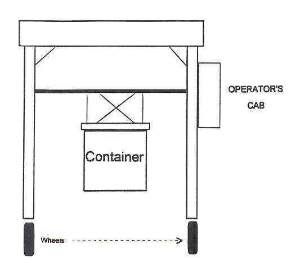
Straight Bill of Lading - See "Bill of Lading."
The grounding of the vessel, causing it to remain fast for an appreciable length of time. Mere contact of the vessel with the bottom without losing momentum and proceeding on course is commonly termed as "touch‑and‑go" and is not considered a stranding.
Strikes Cover - See "SR & CC Warranty."Stripping
To unload cargo from a container; devanning.
Stuffing
To load cargo into a container.
The transfer of the Assured's right of recovery to the insurance company after payment of a claim. The insurance company steps into the shoes of their Assured (usually the cargo owner) and pursues recovery from any third parties responsible for the loss.
Subrogation Receipt
A document signed by the cargo owner acknowledging receipt of payment of a claim, and assigning its rights of recovery (against any third party) to the insurance company.
A policy issued on behalf of two or more insurance companies who "subscribe" to a stated percentage of the coverage. In the event of default of any of them, each company is only liable for its stated portion of the risk and not that of any other insurer. Also known as a "Joint Policy." This is not reinsurance. see "Coinsurers."
Substituted Expenses
Expenses incurred to prevent or reduce a loss for which the insurance company would have been liable.
Sue and Labor
Action of the Assured or its representative to prevent or minimize loss or damage to insured property for which an insurance company would be liable. The Assured is required by the insurance policy to take this action so as not to jeopardize the insurance claim. See "Sue and Labor Clause."
The clause in a marine policy requiring the Assured, in the event of a loss, to act as a prudent uninsured to prevent or minimize damage by taking steps to save and preserve the property from further loss or damage. The clause provides that charges or expenses reasonably incurred in preserving the property are recoverable from the insurance company, if the loss itself is recoverable.
Summary Judgement
A ruling by a judge that there is no genuine issue of material fact and that the party bringing the motion is entitled to prevail as a matter of law.
SuperCargo
The cargo owner's agent or representative who travels on the ship with the cargo to supervise the loading, stowing, and discharging of the cargo and to handle any purchases or sale of cargo. Before the advent of rapid communications, supercargos were seagoing merchants engaged in trade as the vessel made its voyage. Today, they can still be found on chartered vessels.
Superstructure
The structure above the main deck of a vessel.
Surge - See "Vessel Movement."
Survey
An inspection report issued by a marine surveyor to show the condition of cargo, vessel, or other maritime property, either before or after a loss.
Surveyor
A marine specialist who inspects cargo, vessels, and other maritime property to determine:
1. The condition and/or value of property. Condition can include adequacy of packing, stowage aboard the vessel, and/or towage arrangements. The surveyor is not an insurance company loss adjuster, but an independent expert who acts without prejudice to the parties involved.
2. The cause, nature, and extent of damage and recommended methods of repair and/or replacement. The surveyor is not an adjuster, and all actions are without prejudice to the insurance policy terms and conditions.
Sway - See "Vessel Movement."
Sweat Damage
Cargo damage caused by water condensing from humid air inside a container or hold of a vessel due to a drop in the outside temperature.